


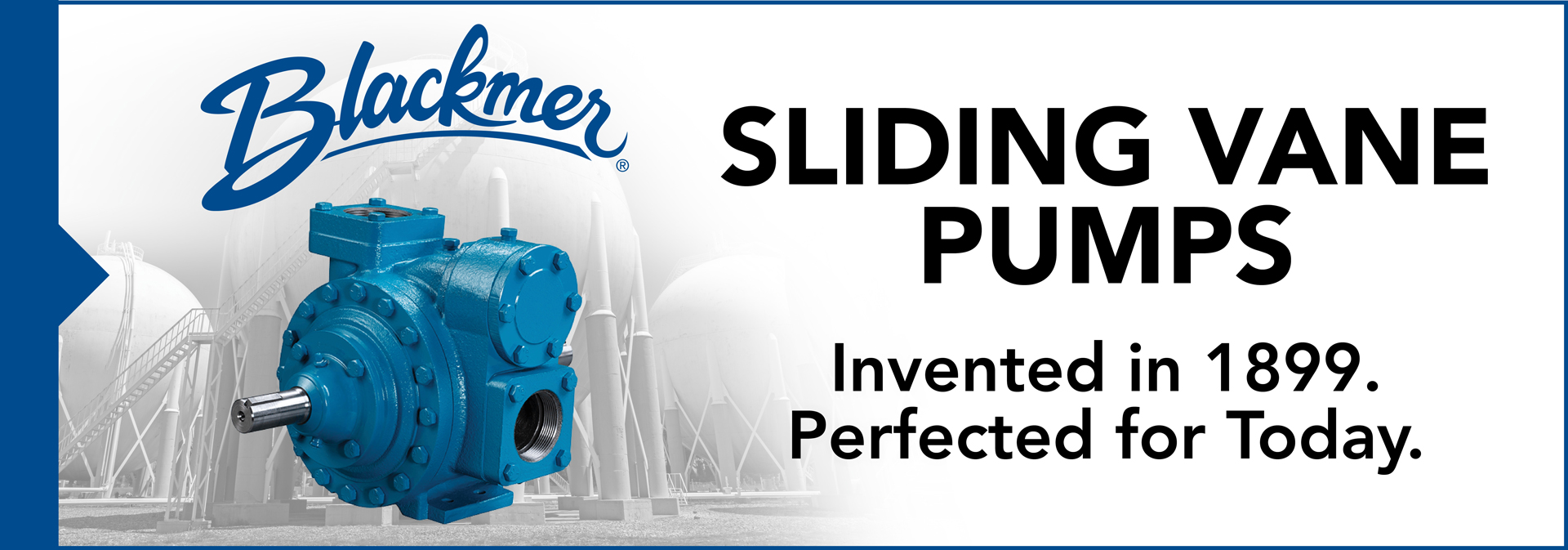
Positive displacement (PD) sliding vane pumps can provide operational advantages over centrifugal pumps in applications requiring high suction lift, according to Chris Hordyk, application engineering manager at Blackmer.
Suction lift—the vertical distance a pump can draw liquid from a source below its centreline—is a common requirement in industrial applications such as railcar unloading, fuel distribution terminals and chemical processing facilities. However, achieving reliable suction lift becomes increasingly challenging as inlet pressure decreases, raising the risk of cavitation, which can damage pump components and reduce operating efficiency.

Hordyk explains that while centrifugal pumps remain widely used across industry, they require priming before operation because they cannot safely run dry. Conventional centrifugal pumps must have liquid in the pump casing before startup to prevent overheating and potential seal failure. Even self-priming centrifugal pumps retain liquid in an onboard reservoir and still require manual monitoring and maintenance of the priming fluid.
These additional steps can increase maintenance requirements, extend startup times and add operational complexity.
By contrast, positive displacement sliding vane pumps are capable of dry-run operation, enabling them to self-prime without requiring liquid to be present in the pump at startup. According to Hordyk, this capability allows sliding vane pumps to achieve significantly greater suction lift than centrifugal pumps in many applications.
When operating under wetted conditions, sliding vane pumps can achieve suction lifts of approximately 25 ft (7.6 m), compared with around 15 ft (4.6 m) for typical centrifugal pumps.
The performance difference is largely attributed to the pump’s operating principle. Sliding vane pumps use non-metallic vanes that extend from a rotating rotor to create sealed pumping chambers. As the rotor turns, the expanding chambers generate a vacuum at the pump inlet, allowing liquid to be drawn into the pump. Because the pumps are designed to tolerate dry running during startup, they avoid many of the overheating issues associated with centrifugal designs.
Hordyk notes that effective air and vapour management also plays an important role during the priming process. Sliding vane pumps can be equipped with supply vessels or other accessories that allow trapped air or vapour to dissipate, enabling faster priming and more reliable operation.
The article also distinguishes between wet and dry suction lift. Wet priming relies on residual liquid remaining in the pump or pipework, while dry suction lift requires the pump to generate sufficient vacuum to lift liquid from an empty system. Although wet priming generally provides improved performance, the ability of sliding vane pumps to safely operate dry enables them to self-prime without additional equipment.
Other pump technologies—including centrifugal, screw, progressive cavity and lobe pumps—may require external priming systems such as vacuum pumps or compressors when operating under dry conditions, increasing installation costs and system complexity.
According to Hordyk, selecting the appropriate pump technology for high suction-lift applications can improve operational efficiency, reduce maintenance requirements and simplify system design. He concludes that sliding vane pumps are well suited to demanding liquid-transfer applications where reliable suction lift, consistent flow and dry-run capability are key operational requirements.
For more information visit www.psgdover.com/blackmer